
VALENTINO VANNINI
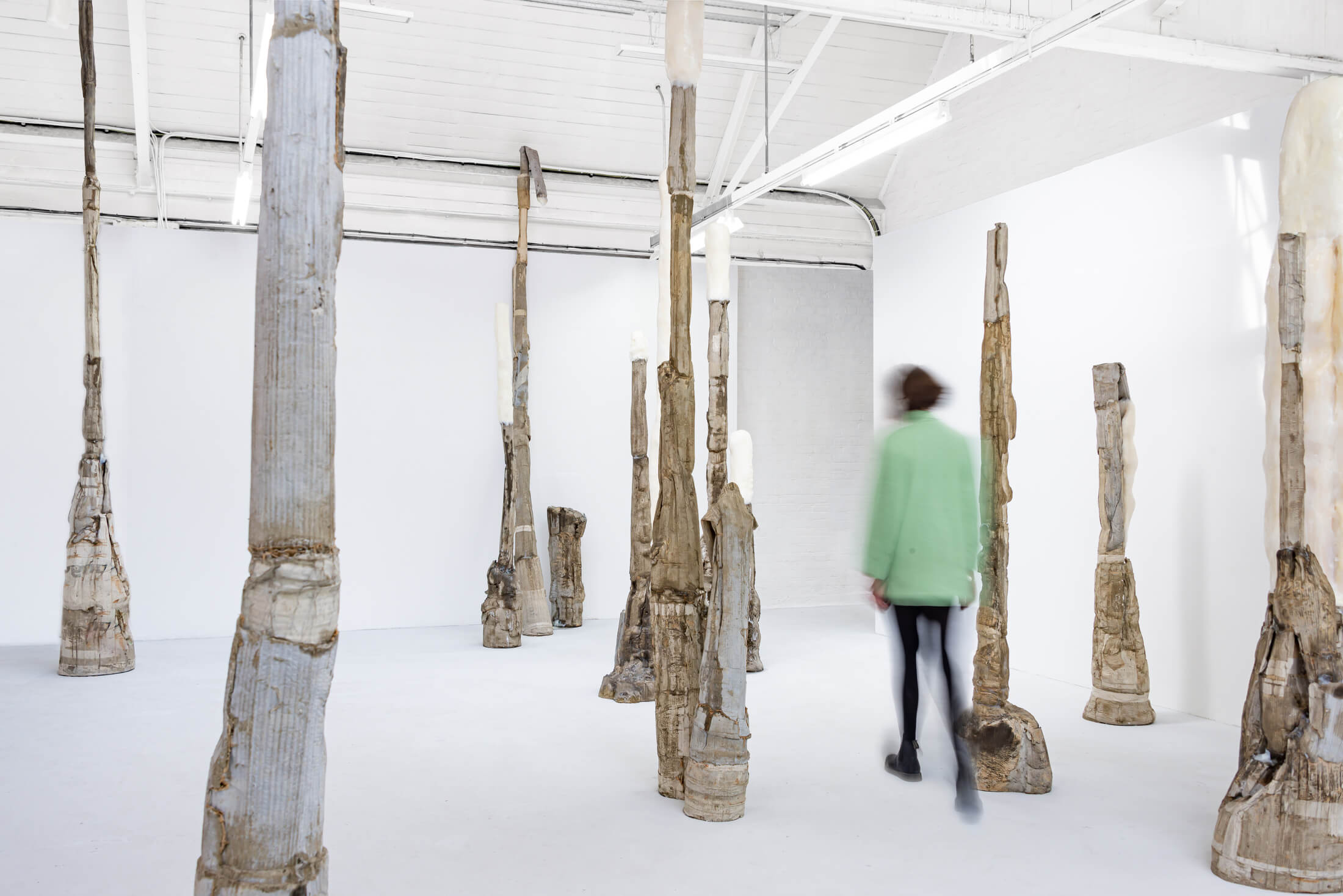
Valentino Vannini’s practice explores how materials, bodies and spaces connect through processes of tension, transformation and exchange.
Working across sculpture, drawing and print, he approaches materials as active agents shaped by context, capable of holding and transmitting meaning.
Through juxtaposition, thresholds and shifting limits, his work opens spaces where fragility, resistance and connection can emerge, inviting a dialogue between internal and external boundaries.
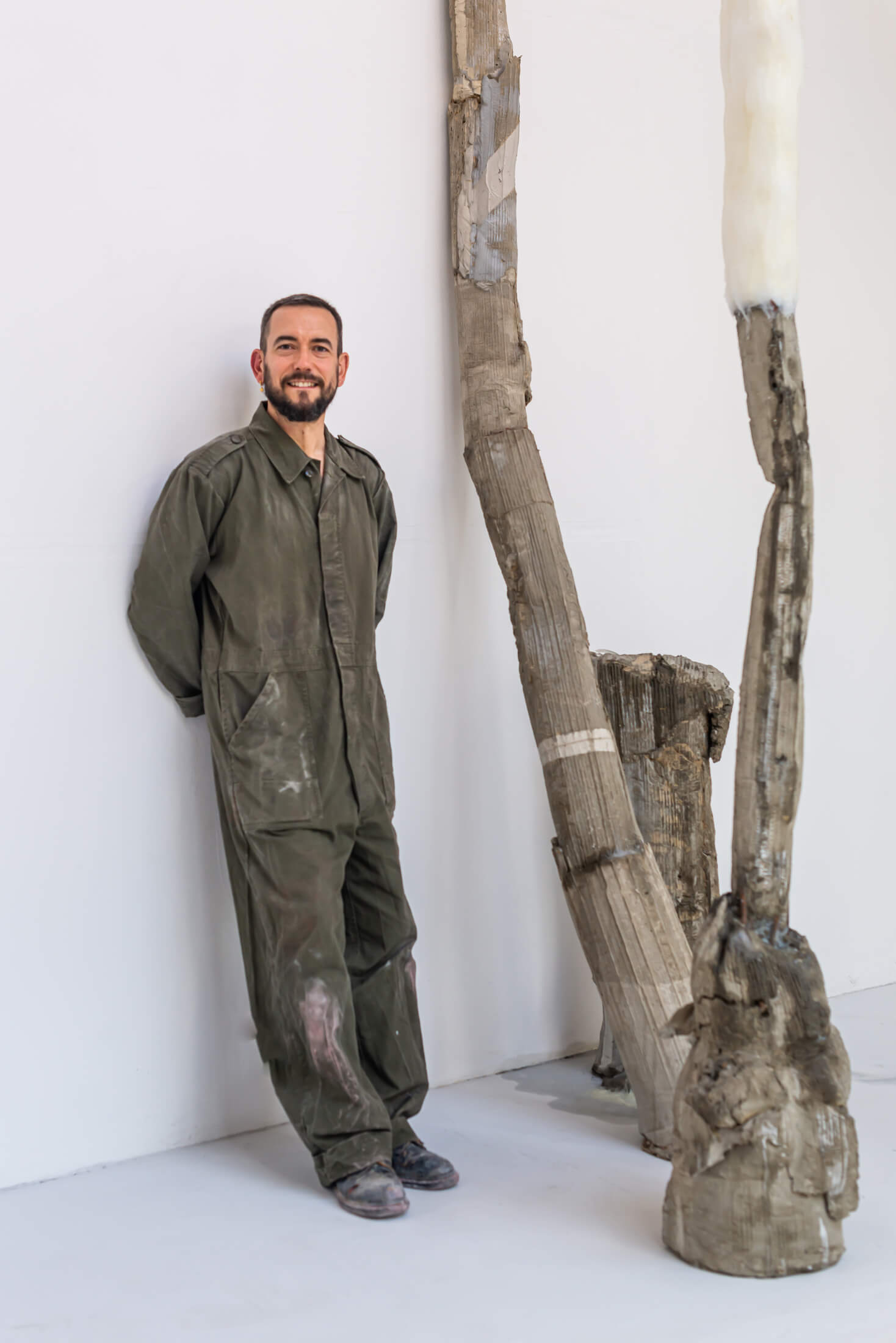
CONVERSATION
Current Work
How would you describe your artistic practice?
I’m a multidisciplinary artist based in London, working across sculpture, drawing and print. I approach material through a notion of sensual plasticity, a condition where materials remain responsive, unstable and open to transformation. I am interested in getting lost in that process, allowing the material to guide decisions.
Materials are central to my practice. Materiality becomes a language through which I articulate ideas. Materials do not exist in isolation; they carry context, histories and associations. I use them to question authority, probe confinement and test limits, often pushing them towards fragility or collapse. Through this, I explore how boundaries are formed, negotiated and sometimes undone.
What themes or ideas are central to your work right now?
Since the beginning of the year, particularly during a residency in Stavanger, Norway, I have been developing work around the idea of thresholds. The landscape there revealed a continuous blurring between land and sea, which led me to reflect on how such conditions affect human experience.
The harbour and the city operate almost like a permeable membrane, with constant movement of people, goods and ideas. This circulation brings exchange and contamination, but also tension, especially in places experiencing rapid flows of tourism.
Ultimately, my work returns to the idea of boundaries. Some are imposed and restrictive, others necessary, and some can be shifted, softened or entirely removed. This instability, between separation and connection, is what I am currently exploring.
What projects or exhibitions are you currently working on?
At the moment I am working extensively with glass, using very thin filaments, known as stringers, to create delicate, almost imperceptible structures that resemble fragile barriers, similar to chain-link fences. I often combine glass with wax. Both materials respond to temperature, and both hold a strong relationship to the body. Glass can evoke capillary forms, like blood vessels, while wax carries a long history of anatomical representation.
This body of work is currently presented in the group exhibition Could You Come to Me at Ione & Mann, where a piece developed during my residency in Stavanger, Norway, is on view. The project sits within a broader sequence of recent and upcoming work. I opened the year with the outdoor exhibition Can You Stand the Rain?, followed by the duo show To Lure, To Hunt, To Catch. I also recently installed a solo exhibition in Tuscany titled Mai Così Vicini – Never So Close. Upcoming projects include the group show Bending Time in London, Survival in Wrocław, and a residency in Sicily in July.
What inspires your work?
I collect images through photography and drawing, building a personal archive of references and impressions that I return to over time, often combining visual material with quotes or paraphrased passages from texts I am reading. What might appear as new directions in my work often already exist in latent form within this archive, waiting to be activated.
For me, the work is not complete when it is produced; it becomes resolved through installation. Placement, spatial relationships and the dialogue between works are essential. Pieces are often reconfigured and remain responsive to their surroundings rather than existing as fixed, autonomous objects.
These spatial encounters, and the way works shift in response to each context, actively feed back into my practice. They generate new questions, images and material decisions, becoming a continuous source of inspiration for future work. Moments of failure, accident or unexpected transformation are also generative, often opening directions that could not be anticipated in advance.
Exploring your identity
How would you define your visual or brand identity?
My visual identity is grounded in a material-led approach that foregrounds tension, transformation and context. I often begin with materials sourced from my immediate surroundings, whether urban or natural, sometimes casting directly from specific sites in London to capture traces of encounters rather than fixed representations.
A defining element is the juxtaposition of contrasting materials, creating friction between opposing properties. Materials may resist one another or enter into dialogue, as in combinations such as concrete and Vaseline, or glass and wax.
Central to my work is a commitment to material honesty. I do not conceal inherent qualities. Wax bends, glass breaks, and these behaviours form a recognisable language within my practice. This language operates across different scales, from intimate details to larger spatial configurations.
How does transformation or change play a role in your work?
Transformation is fundamental. Breakage, alteration and exposure are not accidents but active components of the work.
In outdoor pieces such as Apparatus I & II, first installed at the Phoenix Garden, I relinquished control. The works were exposed to weather, debris and animal interaction, all of which altered their form and perception.
I installed them in early autumn, and by the following day they were already partially covered in leaves. This gradual accumulation became part of the work itself. When I later brought them back into the studio, I could not separate them from that experience. It shifted my approach, reinforcing the importance of working with change rather than resisting it.
What values or ideas do you aim to convey?
Through a queer lens, I reflect on boundaries and the spatial logic of queer experience, though I do not want the work to be confined to that reading. It is a framework for thinking, not a fixed interpretation.
Through materiality, I aim to open conversations. I am interested in how tactility and hierarchies of materials operate within an increasingly touchless society, where contact is mediated or avoided. I want viewers to reflect on their own boundaries, physical, social or psychological, as well as on the body, which can resist or behave unpredictably.
Interpretations remain open and contingent. Different contexts generate different readings, shaped by personal memory and association. For me, the work is about enabling dialogue rather than prescribing meaning.
How you bring your artistic identity to life
How do you express your identity through presentation?
At present, my process unfolds organically. Opportunities emerge through relationships and meaningful contexts. Projects often begin with observation, conversation or self-initiated proposals.
I do not see identity as a fixed foundation for my work; rather, it is something that is continuously negotiated through interaction with others and with context. For this reason, the work is less about individual identity and more about relational experience.
This way of working feels protective, as it allows the practice to remain aligned with my intentions rather than external expectations.
Do certain elements feel signature to your practice?
Rather than a fixed visual style, what feels signature in my practice is an approach grounded in material exploration and experimentation, informed by theory and critical thinking. It is less about defining a stable language and more about allowing forms, meanings and materials to contaminate, overlap and spill into one another, resisting containment or categorisation.
Engagement with others is also central. Studio visits and conversations are part of the process, and I value how different interpretations emerge. At the same time, making requires solitude. I need a degree of privacy in order to take risks and experiment freely.
Material behaviour remains a constant. Its capacity to resist, transform or fail runs through the work, shaping outcomes rather than illustrating pre-defined ideas.
In that sense, the refusal of a fixed identity or stable form may itself be a queer position within the practice.
Looking ahead
What is your next focus?
Until the end of June, my time is largely dedicated to preparing exhibitions and continuing ongoing projects. A residency in Sicily in July will offer a more open and exploratory phase, an opportunity to experiment, exchange and work without the pressure of a defined outcome.
I want to keep that period flexible, allowing space for new connections and directions to emerge.
What would you like to explore more in the future?
I want to push collaboration further, particularly where practices begin to overlap and destabilise one another. I have been in conversation with a poet, and I am interested in developing a work where language and material operate in parallel rather than illustration.
I am also looking to re-engage with fashion, not as product but as a site for spatial and image-based work, through publication and in-store installation contexts. Given my background, this is less a new direction and more an extension that I want to activate more deliberately.
published on 29th April 2026
"Could You Come to Me" installation views:
IONE & MANN, London, 2026. Artwork © Valentino Vannini; Courtesy of IONE & MANN.


2026
lampworked glass, metal mesh and wax
114 x 84 x 5 cm

2025
man-made found rocks, kiln-shaped glass
variable dimensions

2025
kiln formed glass, found tar
39 x 25 x 19 cm

