
JULIEN-ARNAUD CORONGIU
Paris
Mars 2024
Born in 1988 in Forbach, Julien-Arnaud Corongiu lives and works in the Paris region. Trained in Liège and Bourges, he was awarded the First Prize of the Pierre David-Weill Drawing Prize by the Académie des Beaux-Arts in Paris in 2022.
His practice explores identity, determinism and the relationship of the individual to the world. Through painting and drawing, he places the human figure at the centre of his work, often caught in states of isolation, fatigue, suspension or disappearance.
Julien-Arnaud Corongiu's subjects are deeply personal, shaped by lived experience, memory and introspection, yet they open onto wider questions around social relationships, exclusion, melancholy and the ways an individual can be erased or defined by their environment.

CONVERSATION
Current Work
How would you describe your artistic practice?
The main axes of my work are identity and the relationship of the individual to the world. I also question determinism, exclusion and forms of subjugation. More generally, I come back to the human condition, loneliness, melancholy, isolation, absence and the mechanisms that erase the individual.
There is a large autobiographical part in my work. The human figure is at the heart of my practice. What I represent, I have often experienced, or these are subjects that inhabit me and belong to my history. I cannot choose something at random. The subject has to impose itself, so that I can translate it plastically. This notion of sincerity is fundamental in my work.
What themes or ideas are central to your work right now?
At the moment, I am working around introspection, my relationship to others, and human and intimate relationships. In a current series, I represent people with whom I have lived, in order to question the sometimes complex feelings that can come from this proximity.
Rather than a clear break from what I was doing before, I see it as a continuation of it. It is still linked to identity, family ties, intimacy, determinism and social relationships. There are obsessions and subjects that come back from the beginning of an artistic practice.
What projects or bodies of work are you currently developing?
I am currently working on a new body of work with several series, mainly dealing with social and intimate relationships.
Several years ago, I also made a series with soldiers based on archives from the two world wars. The soldiers had nothing to do with my own story, but I used the figure of the soldier, and especially the uniform, to question the cancellation of identity while also expressing something personal. The uniform can erase the individual for the benefit of a group.
In more recent series, I try to anchor the figure in a contemporary time, especially through clothing, which can act as a kind of modern uniform. It says something about a person, a social class, an environment or a social background. These visual markers allow me to question social determinism.
What inspires your work?
Life, and the events that pass through it. The human condition, determinism, the place of the individual in the world, and how the environment or social context can be decisive in their construction.
There are also forms of exclusion, differences in social class, injustices. Any form of art can feed my reflection: cinema, literature, music, exhibitions, art history. But when it comes to my own work, the questions are very personal. Everything we live through can impact what we do artistically. I feel that we transform it and translate it into forms of art.
Since my second solo exhibition, even if the work has always been very personal, it has become even more so. There is an autobiographical side, even if I often take a detour so that it does not become too literal. Sometimes it is not interesting to say everything. It is important to leave a part of mystery and allow the painting to speak, or to live by itself.
Exploring your identity
How would you define your visual identity?
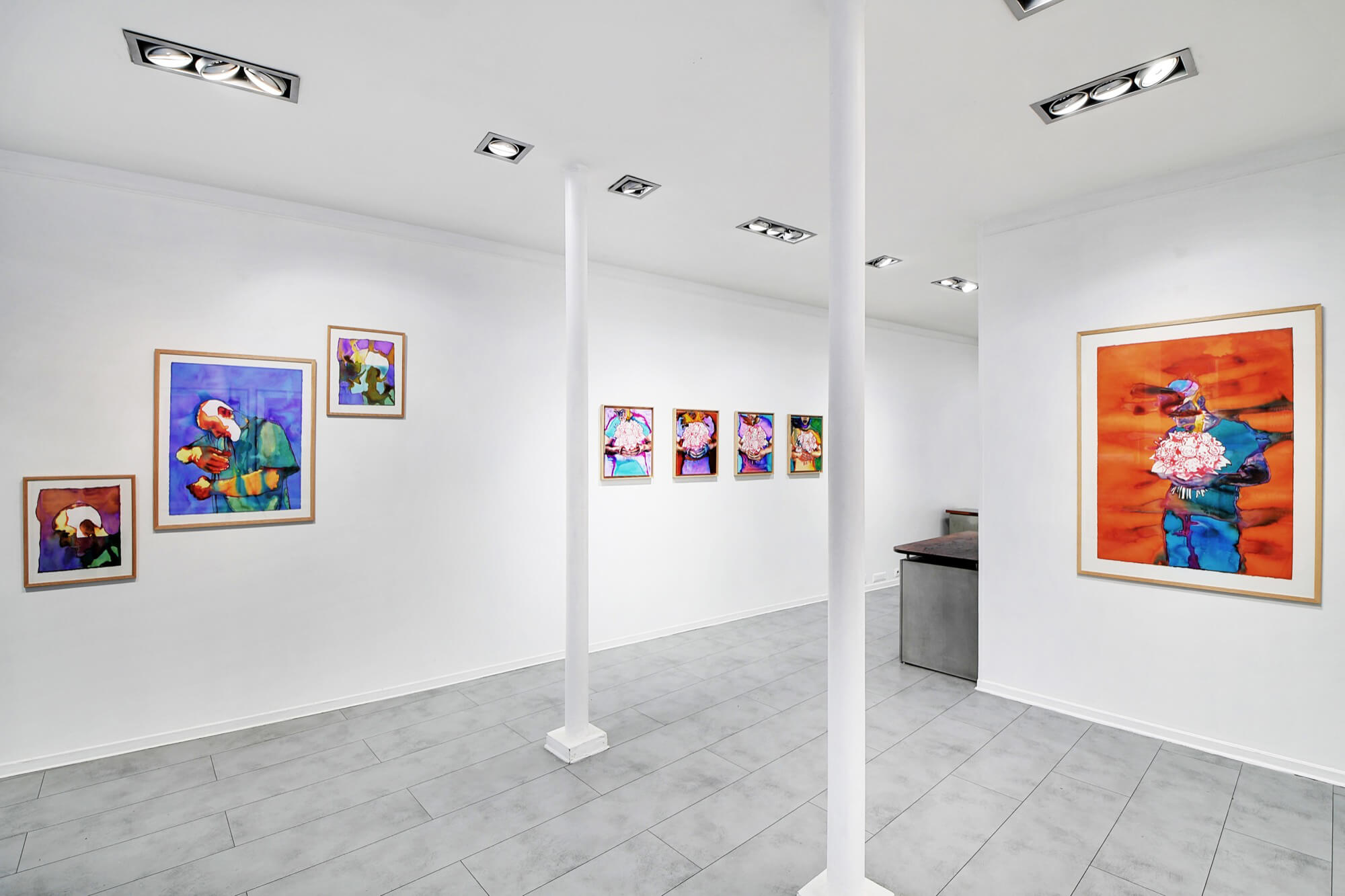
Colour is an important part of my visual identity. I like to soften subjects that could be described as serious with brighter or happier colours. I like this duality, which echoes life, where things are rarely completely one thing or the other.
At the same time, my charcoal drawings remain anchored in black and white. I like this radical contrast with my very colourful painting work.
Colour stimulates me more. With black and white, there can be a kind of efficiency, perhaps fewer risks, fewer accidents. With colour, each colour has its place. A work can fail because of the wrong colour. With ink or watercolour, there is almost no possibility of revision, no room for error. I think I like this notion of accident and risk.
How does the human figure shape your work?
The human figure occupies a central place. A body, by its posture or clothing, can have a political dimension and create a whole social imaginary, anchored in our collective unconscious.
In my work, bodies are often bent, bowed, head down, on their knees, suspended or in struggle. They can appear in fatalistic postures, marked by defeat, by an environment or by a story. It is as if they carry the weight of their existence.
The backgrounds are more like mental landscapes than real ones. There are almost never details or spatio-temporal elements. The bodies float, are submerged, lost, melt, or are crossed by their surroundings. The background and the figure often become inseparable.
Faces are often erased or not clearly defined, like a progressive decomposition. They translate states or personal stories. It is a way of revealing interiority, making the invisible visible as a form of mental presence.
I also try to create a hierarchy between the human being and their clothes, to highlight the interchangeable side of clothing, its social alignment or ephemeral aspect, and give full importance to the human figure.
What values or ideas do you aim to convey?
For me, the most important thing is emotion. Not necessarily the exact emotion I wanted to transcribe, but an emotion specific to the person looking at the work.
My work is very personal, even autobiographical, but the very personal can paradoxically become universal. Everyone can have their own interpretation. That is what is beautiful in visual art, and more generally in any form of art.
Titles are also very important in my work. They can give an indication, but I like them to remain quite vague or enigmatic. I am attached to a poetic and open form, rather than a purely explanatory title.
I like the ambiguity that art allows. I like that there are different grids of reading, and that a work raises questions more than it gives answers.
How you bring your artistic identity to life
How do you express your identity through presentation?
Like most artists today, I use Instagram to promote my work, and it is difficult to do without it. There is a good side to it, but there is also such a strong presence of this medium in the art world that it becomes difficult not to take part in it, especially for emerging artists.
It can create visibility and reach a wider audience. But I do not think we should give it more importance than it already has. A work is ideally seen in the real world, not through a screen, whenever this is possible. Instagram can be a gateway, a form of access to culture, but it should not replace the real experience of physically confronting a work.
I use it mainly in a professional way, to show my work. I also have a website, which gives another, more professional dimension.
Do certain elements feel important in the way your work is shown?
For me, all these elements are secondary. The most important thing in an artwork is precisely the artwork itself. I am not very interested in artifice. I like the work to exist by itself, with a sober and clear presentation.
I like exhibitions where space is given to the work, where you let it breathe, and where the space becomes part of the exhibition. My work can be very colourful, so having space around it matters. This also allows dialogues to take place between the different works.
The hanging of an exhibition is very important. It can almost be seen as a work in itself, because it is part of the whole exhibition. You do not choose works randomly. It has to be thought through.
Looking ahead
What is your next focus?
I would like to return more strongly to painting on canvas, and to oil painting, which I have left aside for a while. I am thinking a lot about larger formats, composition and the place of scale in my practice.
The aim is to give the human figure its full dimension, at a one-to-one scale, and to create a stronger sense of presence, giving the work a more immersive and physical dimension.
What would you like to explore more in the future?
I am also questioning composition, format and the preparation of supports through this return to canvas. The paper I use now was chosen after many tests. I did not choose it randomly. The support can completely change the visual result.
As I return to canvas, I would like to get closer to the rendering I have with ink on paper, where the paint is really absorbed. I would like to use oil or acrylic in a very diluted way, as I do in my works on paper.
Recently, I have also tested other mediums and techniques, such as monotype. I like to experiment and change mediums. There is always a part of research in artistic practice. Some tests open possibilities, and others close certain paths.
published on 11th June 2026
julienarnaudcorongiu.cominstagram
Charcoal on paper
2023

Charcoal and graphite pencil on paper
2023

Acrylic and ink on paper
2023

Acrylic and ink on paper
2024

