DELPHINE GRENIER
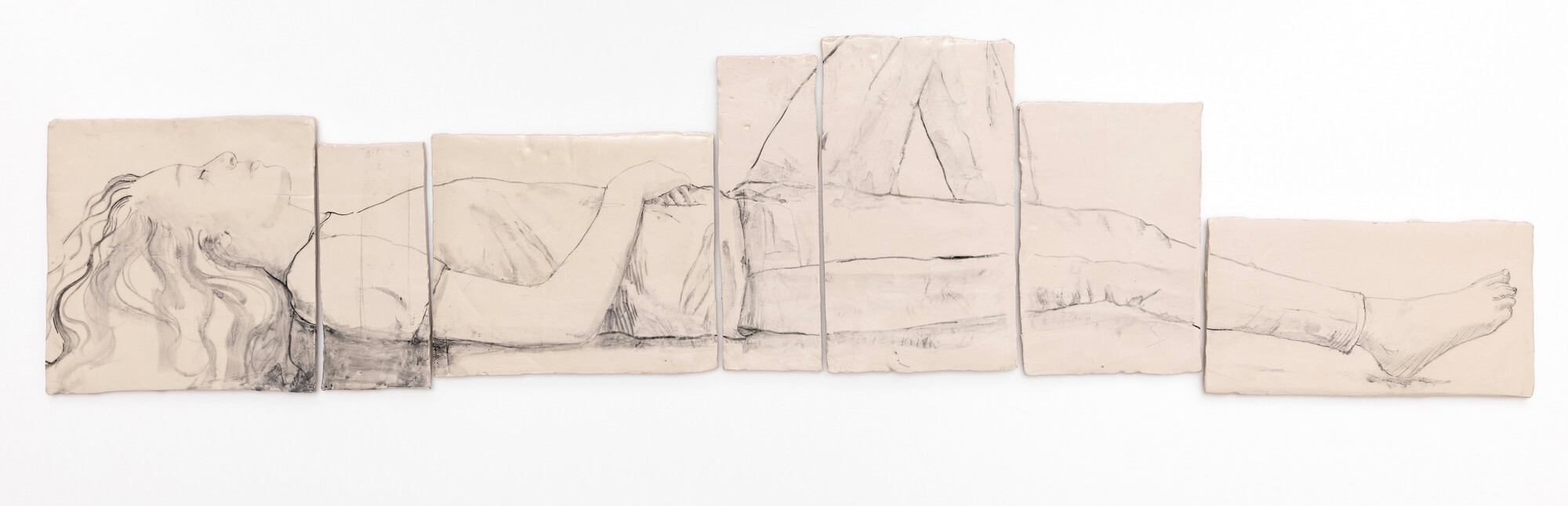
Delphine Grenier’s work moves through memory, disappearance, and the fragile continuity that links us to both past and future. Working through ceramics, sculptural fragments, and the intimate act of drawing on clay, she creates spaces where bodies, animals, and myths coexist in a quiet dialogue between what endures and what fades. For Grenier, drawing on clay is a form of writing that anchors us to ancient gestures and resists the ephemerality of our cloud-based memories. It inscribes a line that can survive us, connecting today’s fragile world to the countless societies that have lived and disappeared. From reclining figures that invite us to feel the ground beneath us to porcelain memorials of vanished species, her practice asks how we remember, what we preserve, and how we inhabit a world that is both breaking and becoming.


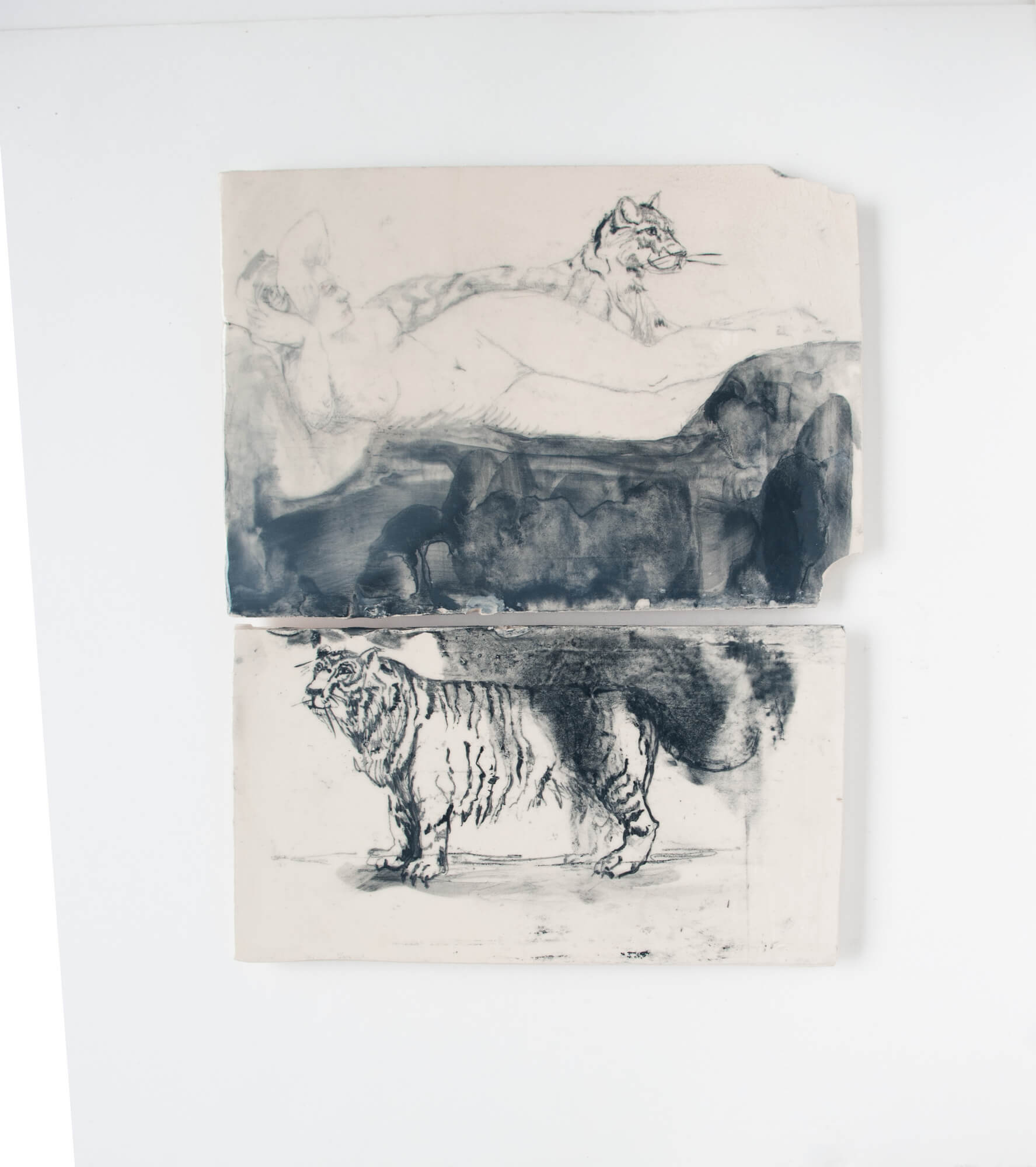
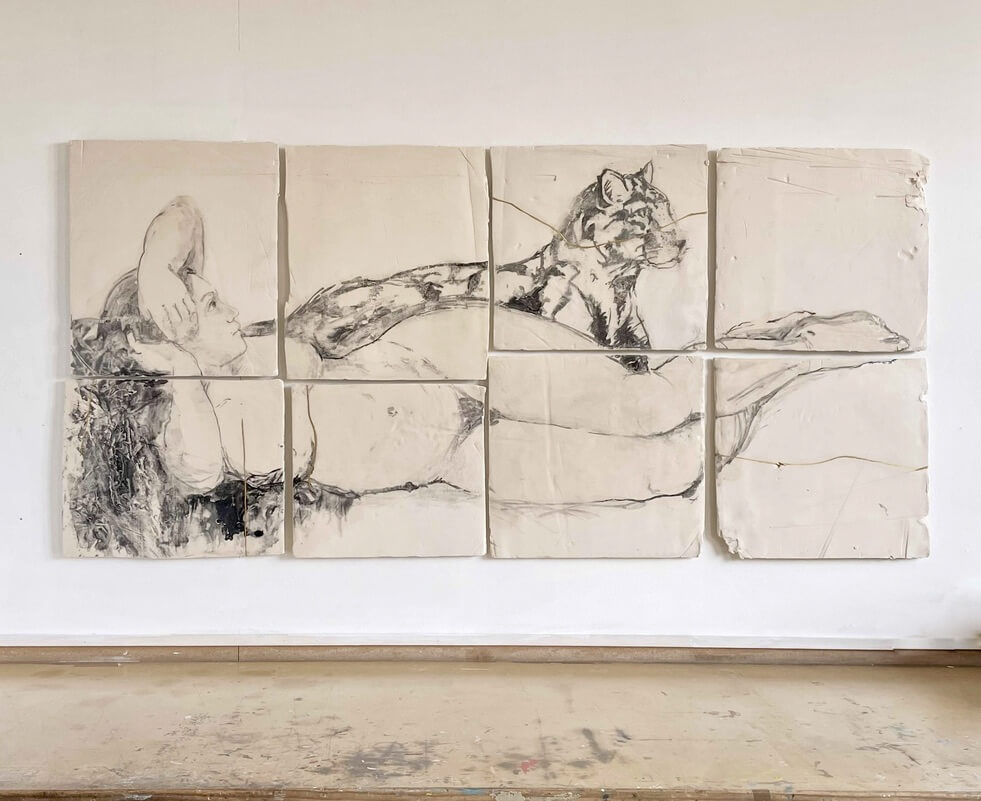

from Petit Eden and Allongé series
CONVERSATION
Current Work
How would you describe your artistic practice in a few words?
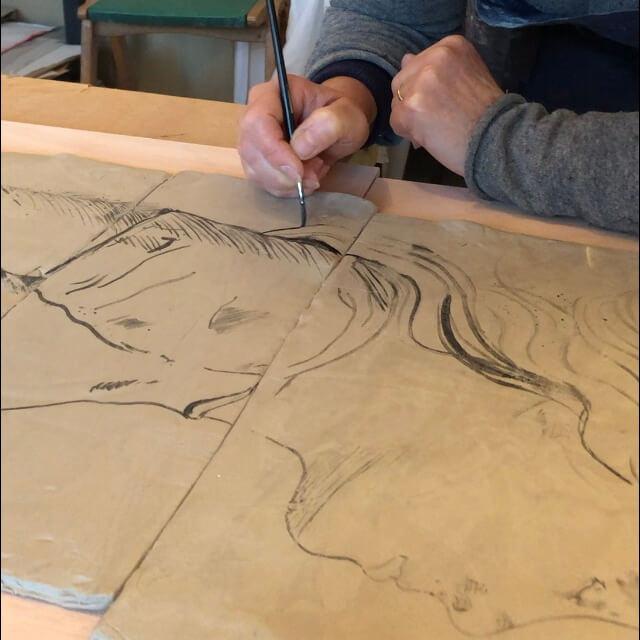
I would describe my practice as a set of techniques and methods that all connect through the question of memory, whether it is mine, ours, or something more universal. Working with ceramics is essential for this. Clay belongs to all the societies that have passed and disappeared, and drawing on ceramic fragments becomes a way of writing something that can last. Today so much of our memory is digital, stored in clouds that do not belong to us. When I draw on clay, I feel that I am staying in line with very old societies or ancestors, creating a link that is indivisible, even if it is not visible. I often feel that we are living in a society afraid of disappearing, but my work does not try to give answers. It is more a way of taking part in a long continuity.
What themes or ideas are central to your work right now?
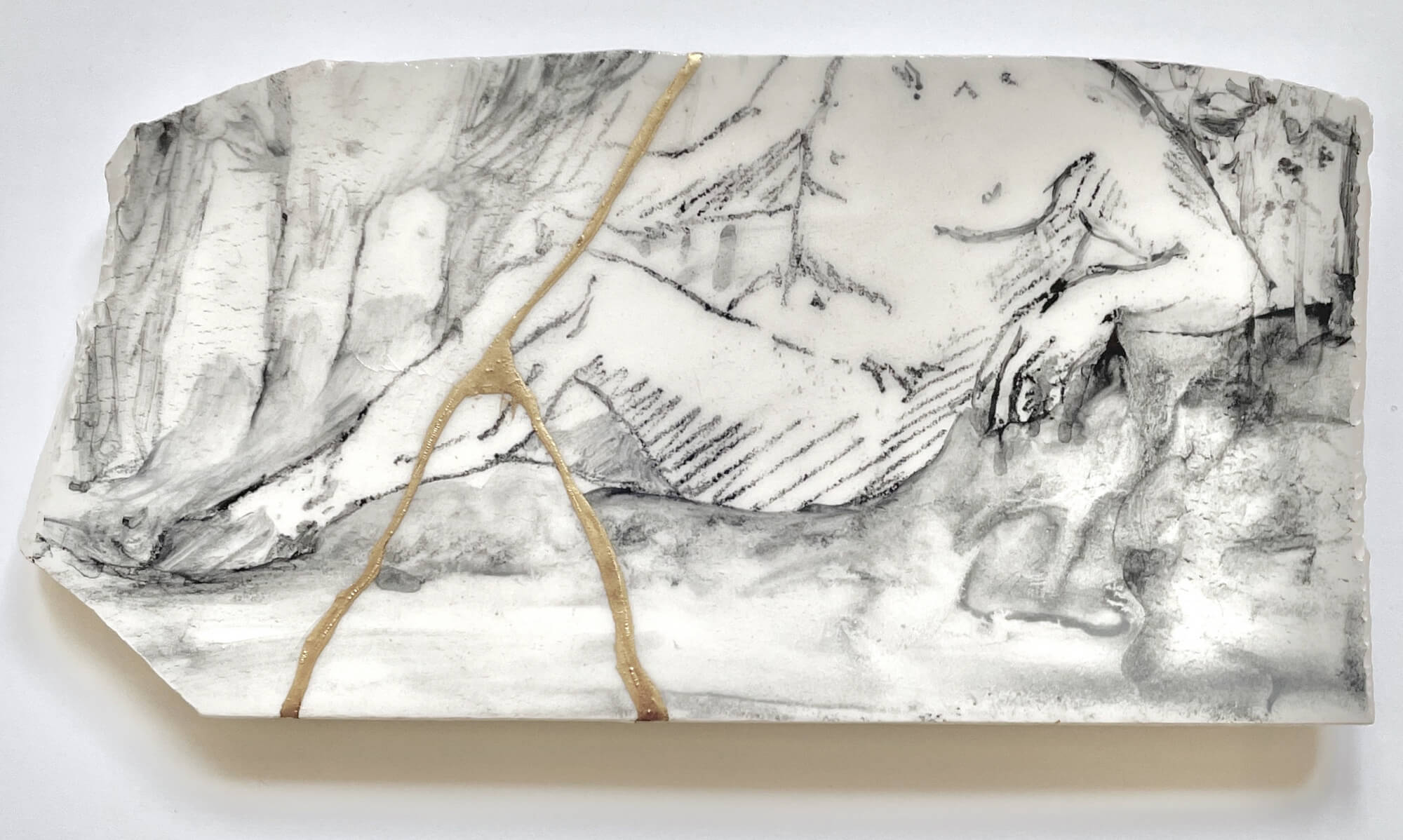
Memory, especially its fragmented nature, remains central in my work. The reclining figure is important for me because when you recline, you can feel what is around you, and when you lie on the ground, you can also feel the living history beneath. The body I represent is often broken, just as memory is broken. We never remember everything. We remember fragments.
I also think a lot about Eden, or the loss of it. In my Petit Eden series, humans and animals appear together, equal and nude, as if they belonged to the same world. I wonder whether paradise was ever a myth or whether today we are in the process of losing it again. Animals play a major role in my work because they naturally carry stories: their temperament, their symbolism, the countries they evoke. When I draw an animal, a narrative already exists. It is inexhaustible.
Are there any projects you are currently working on that you’re excited about?
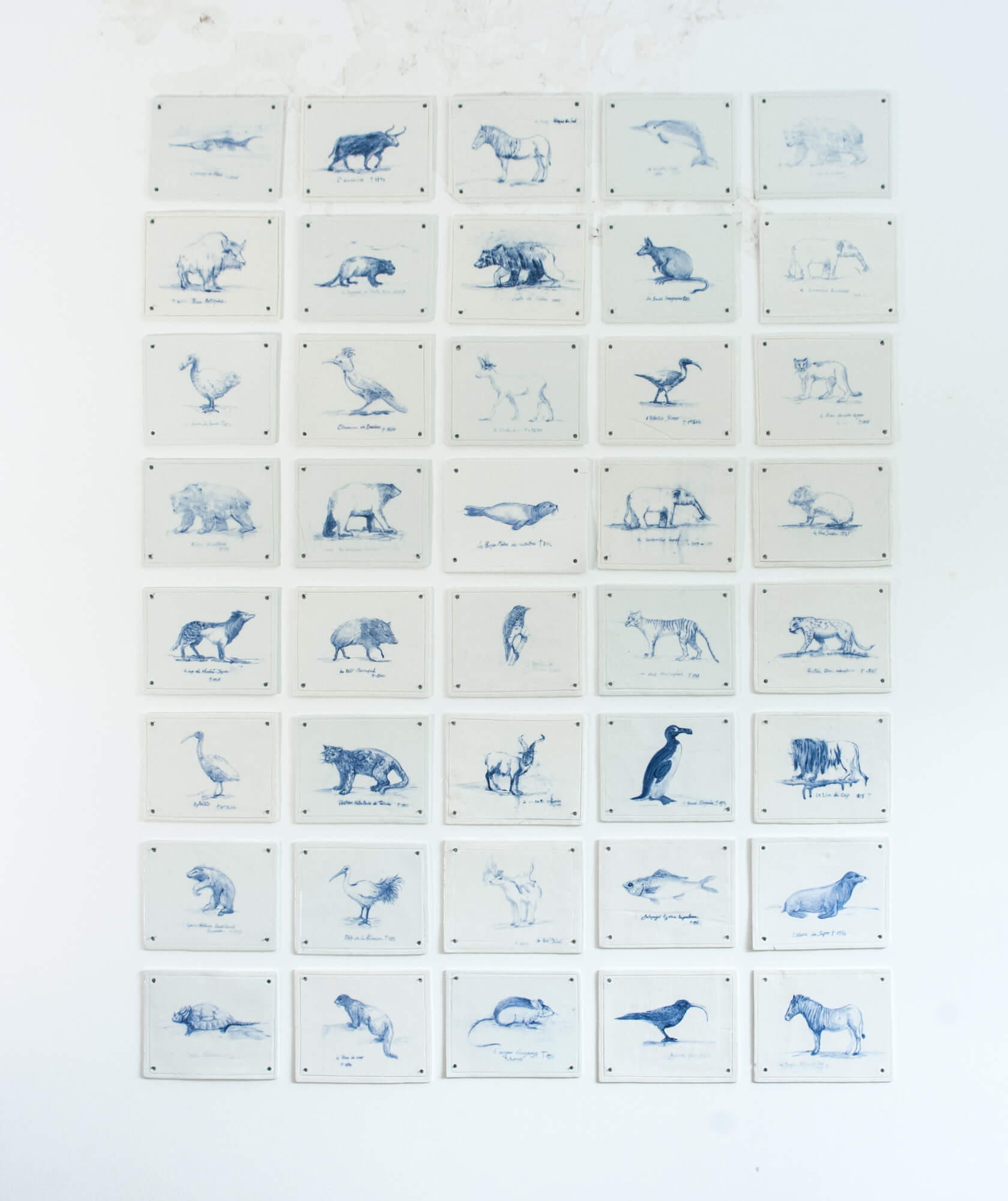
I recently worked on La Réserve, an ensemble of 112 porcelain panels — rectangular pieces that together form a large wall-mounted composition — each with the portrait of an animal that has disappeared. Some portraits are very clear, and others are almost invisible. The title of this work plays with the different meanings of the word “Réserve,” whether it is what a museum keeps out of sight, a natural reserve, or the white space that remains unprinted when printing an image or a text. La Réserve is a memoriam and also refers to votive or funeral traditions. The choice of white porcelain echoes white marble.
The work will be shown in 2027 at the Centre d’Art Contemporain de Montreuil (Centre Tignous) as part of an exhibition on the Anthropocene, which I am also curating. There will be six invited artists, and I also hope to develop performances related to the theme.
Exploring your identity
How would you define your visual or brand identity?
My artistic identity is rooted in continuity, in memory, and in the logic of materials. Ceramics allow me to escape the constraints of the frame and the flat surface of drawing on paper. When I draw on clay and enamel it, the drawing and the material eventually merge. The two become inseparable. My ceramic drawings and sculptures are often slightly detached from the wall, which gives them presence and weight while avoiding the feeling of a simple object.
Are there particular values or moods you aim to convey?
I want the work to become a space that we physically inhabit rather than simply look at. I often imagine installations that surround the viewer. For La Réserve, for example, I have imagined a structure like a hollow column where one could stand inside, surrounded by the images of disappeared animals.
More broadly, my work invites questions that go beyond personal experience: where we come from, what we are doing now, and what will remain of us.
How you bring your artistic identity to life
How do you express your identity in how your work is presented?
I pay close attention to the way the work exists in space. I choose not to place sculptures on plinths or bases because this would turn them into objects rather than keeping them alive within the environment. In the porcelain series Find the Lady, for example, the figures are suspended on the wall and connected by a wall-mounted support instead of resting on a pedestal.
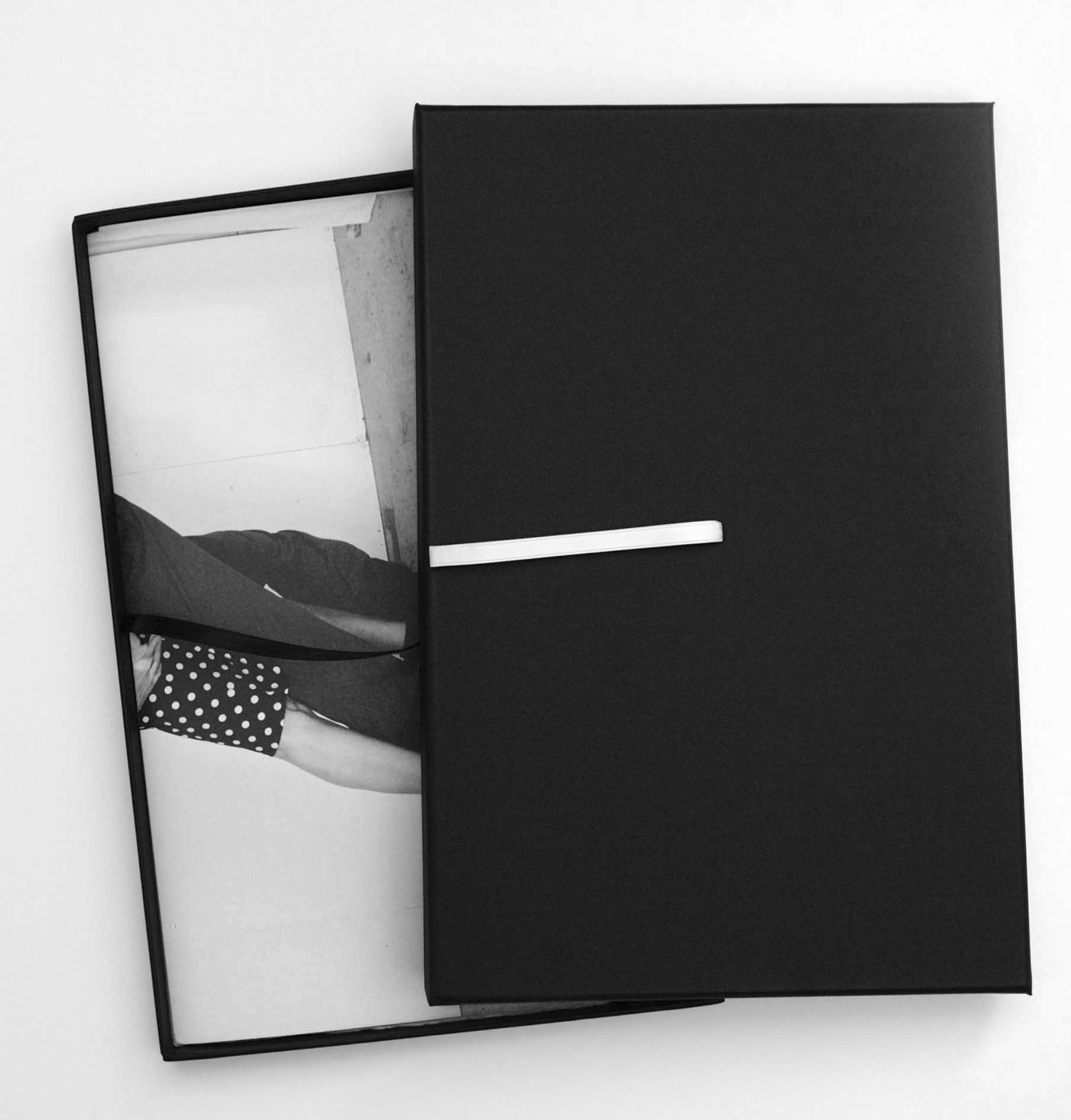
Books have also played an important role in my practice. My artist books, particularly those linked to tango or family history, brought together writing, engraving, performance, and graphic design as complete projects. Although I create fewer books today, writing remains central. It helps me understand what I am doing and sometimes reveals the meaning of works long after I have made them.
Have any of those elements become signature to your practice?
One work that is becoming something of a signature for me is the series of Allongées, as well as the pieces heightened with gold. These are also drawings on clay. Drawing on ceramics has become essential because it allows me to bring together writing, memory, and material permanence.
Animals have also become central because they immediately carry stories and meanings. The fragment is another recurring element, since so much of memory is fragmented. Above all, I always choose materials for their meaning. A material must make sense for the work.
Looking ahead
What’s your next big focus or direction?
I feel that my work is entering a new phase. There was a time when I interpreted my own history, but today I am more drawn to universal questions. I feel an urgency to address themes that concern all of us, especially at this moment in history. The 2027 Anthropocene exhibition is part of this shift. It brings together memoriam, ecological reflection, curation, and collective creation.
Is there something you’d love to do more of creatively?
I would like to develop more immersive installations, spaces that the viewer physically enters. I also want to continue deepening the dialogue between ceramics, drawing, memory, and the living world. I am open to new opportunities, including the possibility of exhibiting in London. I would also like to continue developing the writing aspect of my work, and perhaps return to propositions that combine exhibitions of artworks with performance and text.
published in December 2025
www.delphinegrenier.cominstagram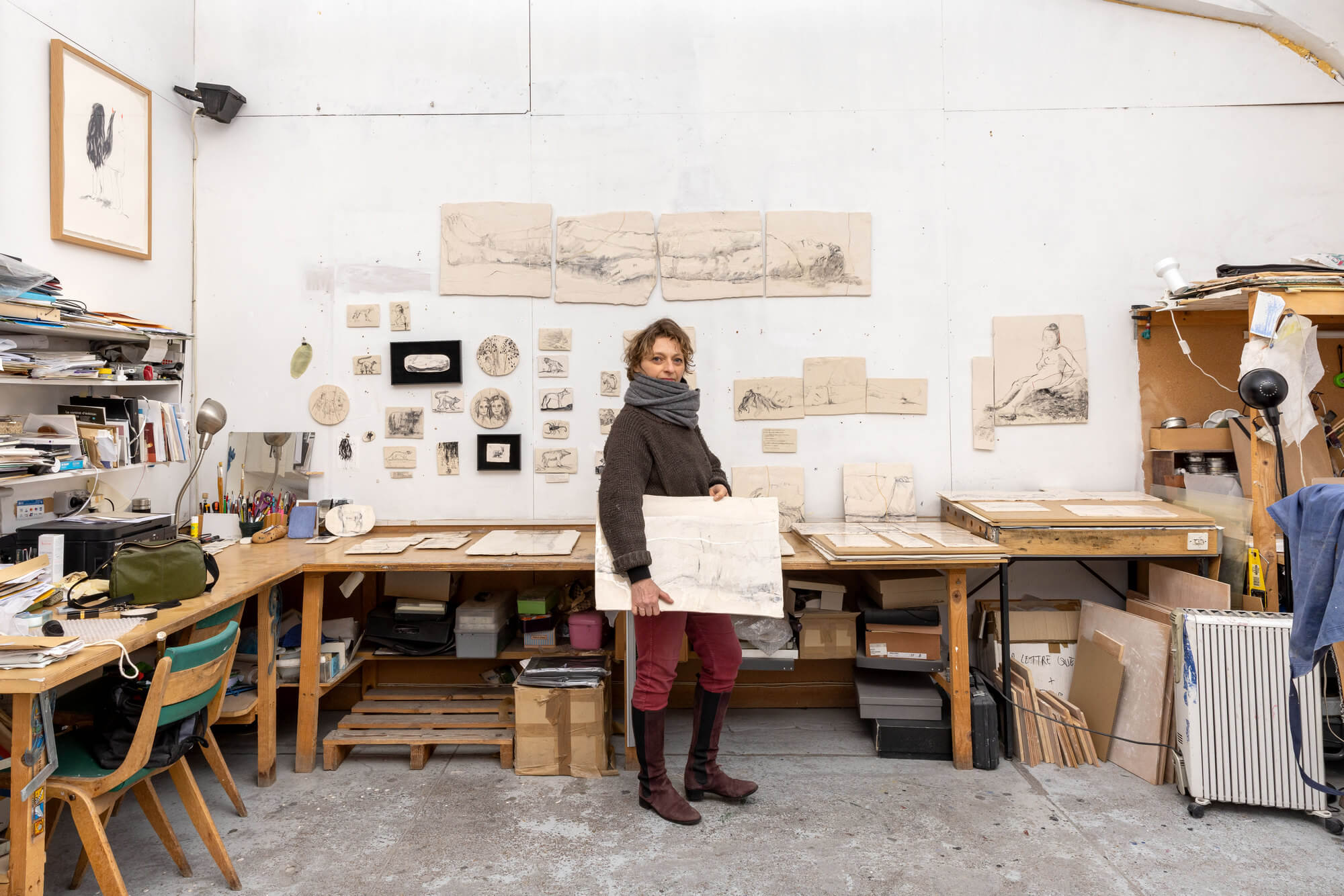

ART SELECTION